Chimney and fireplace service in Chicago
Roughly 495,700 Chicago homes were built in 1939 or earlier. We look at the chimney from the roof and the firebox for free, photograph it and write the price down first.
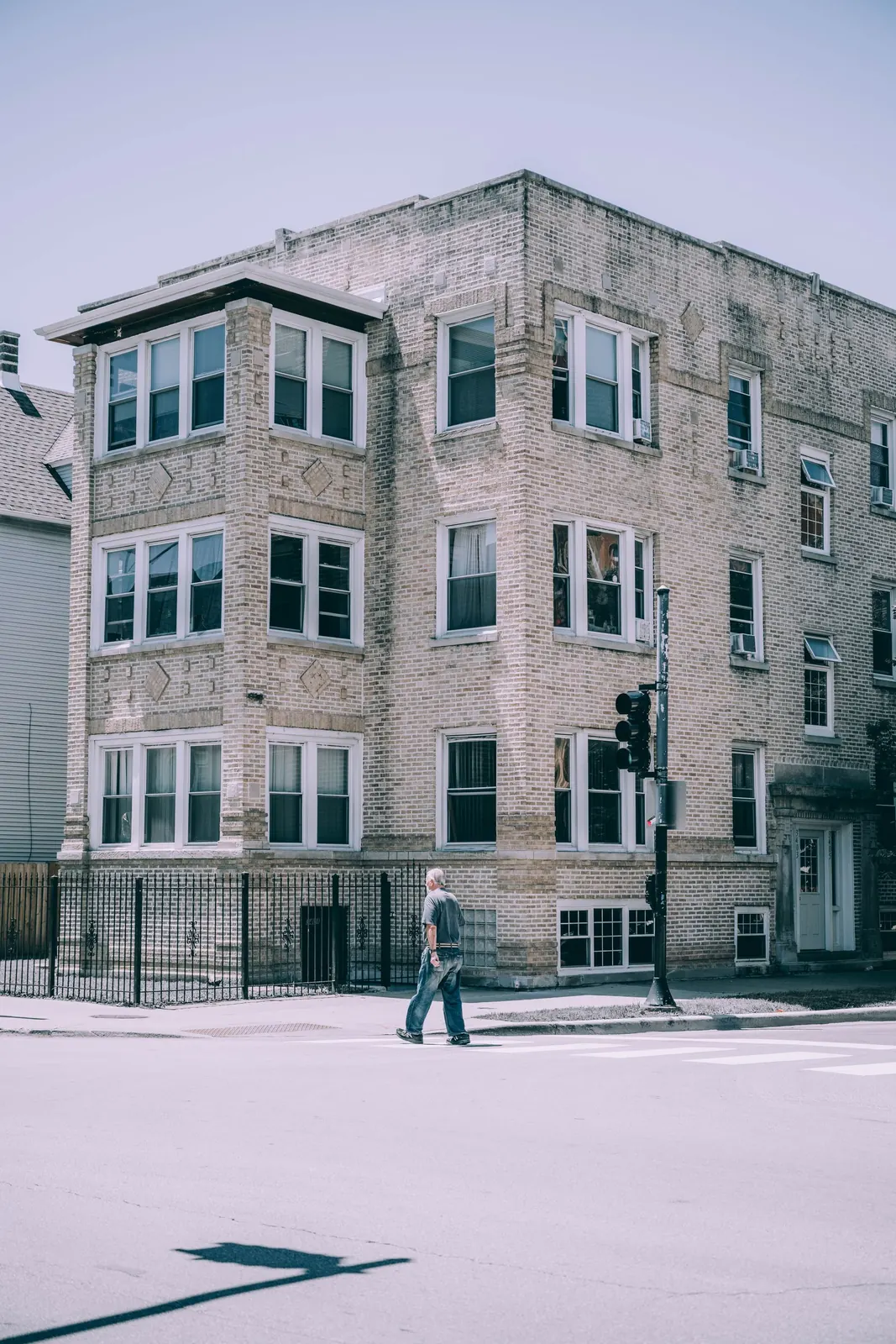
The Census Bureau's 2020–2024 survey puts 38.8 percent of Chicago's 1.28 million housing units in buildings from 1939 or earlier, more than three times the national share, and the city's median home dates to 1953. The housing is stacked as well as old: 13.1 percent of units sit in two-unit buildings and 14.4 percent in three- and four-unit buildings, against 3.4 and 4.3 percent nationwide. That adds up to a great many brick chimneys that serve more than one household.
Most of them no longer carry wood smoke. Utility gas is the main heat in 77.5 percent of Chicago homes, and wood in almost none, so the stack on a bungalow or a two-flat usually vents a furnace or boiler and one or two water heaters, sometimes beside a fireplace flue nobody has lit in years. The free inspection covers every flue in the chimney, from the crown down to the cleanout, with photos and a written price for anything that needs work.
The Bungalow Belt
The Chicago Bungalow Association counts more than 80,000 bungalows still standing, close to a third of the city's single-family houses. They went up in a ring around the center, from the far North Side to the far South Side, between 1910 and the mid-1930s: brick, a story and a half over a full basement, a low hipped roof with deep eaves. That makes most of them 90 years old or more, and the chimney is usually the part of the house that has had the least attention.
On a bungalow the chimney tends to rise along a side wall or through the back of the roof, built in Chicago common brick. That brick came from local clay, was fired buff, salmon or red, and was kept to the sides and backs of buildings while smoother face brick went on the front. The last maker shut down in 1981, so when a brick face has popped we replace it with salvaged commons rather than a new brick that won't match. Bungalow tuckpointing typically runs $500 to $2,500, and replacing spalled brick with salvaged commons $1,000 to $3,500.
- Mortar matters as much as brick. The National Park Service's Preservation Brief 2 says repointing mortar has to be softer and more vapor-permeable than the brick around it, because a harder mix pushes the stress into the brick and cracks or spalls it.
- A crown that was never more than a sloped layer of mortar is the usual first failure on a bungalow stack.
- Furnace swaps leave water heaters alone in clay flues that are now too big for them, which is where a liner comes in.
Two-flat pockets
A two-flat, in the Chicago Bungalow Association's phrase, is basically a stacked Chicago bungalow, and many were built by the same developers in the same years. The association names West Garfield Park, South Lawndale, the Lower West Side and Brighton Park among the densest pockets. Say two-flat here, not duplex. In a typical building one chimney carries the heating appliances of both units, with a flue for each or, after decades of changes, one flue shared by more than it was meant to handle.
When the owner lives upstairs and rents the garden unit, the city's carbon monoxide rules land on the owner. Chicago requires an alarm within 15 feet of every sleeping room, inside any bedroom that has a fireplace or fuel-burning appliance, and in the same room as every furnace, boiler and water heater. The owner supplies and replaces the alarms, the tenant tests them, and the city lists fines of $500 to $2,000 a day for missing ones. A stainless liner sized to the appliances typically runs $900 to $3,800, and an aluminum liner for gas appliances only $625 to $2,250.
Greystone blocks
Greystones began appearing in the 1890s, first in Woodlawn and then in North Lawndale and Lake View, and kept going up into the 1930s. Most are two or three floors, often with a flat on each, and the limestone front always faces the street on a standard 25-by-125-foot lot. The chimneys rise behind that stone front, so from the sidewalk you rarely see the part that needs work.
That is why we look at greystone stacks from the roof. Loose top courses, a cracked crown and failed flashing against a flat roof are the common finds. Rebuilding the top few feet with a new crown typically runs $600 to $1,000, and a rebuild from the roofline up $1,000 to $3,500.
Landmark districts
The Commission on Chicago Landmarks reviews permits for designated landmarks and landmark districts, and its Historic Preservation Division looks at every application so the work doesn't harm the features that earned the designation. Districts run from Wicker Park, Ukrainian Village and the Logan Square Boulevards to Pullman, the Mid-North District, Old Edgebrook and the Longwood Drive District in Beverly. The city's no-permit allowance for small in-kind masonry repairs, up to 50 square feet on buildings up to four stories, may not apply inside these districts.
Outside them, Chicago's Express Permit Program covers in-kind reconstruction of masonry elements such as chimneys, as long as the chimney work is described on the permit. Either way we check what the city requires for your address before work starts, and in a landmark district we help you prepare the photos and scope for the city's review. Since the review exists to protect a building's significant features, matching the brick, mortar color and joint profile is the safe approach.
The lakefront
Being near Lake Michigan cuts both ways. Midway, closer to the lake and more built-up, averages about 106 nights a year at or below freezing against about 121 at O'Hare (NOAA 1991–2020 normals), so the lake takes a little of the edge off. It also feeds lake-effect snow: on November 9 and 10, 2025, the National Weather Service recorded 5.7 inches in West Ridge and 3.5 inches in Edgewater while O'Hare recorded 1.7.
Wet snow piled against a chimney on a flat or low-pitched roof finds every gap in the flashing as it melts. On lakefront and Far North Side buildings we see more leaks at the flashing and crown than at the brick itself. Flashing replacement typically runs $300 to $1,800, leak sealing $150 to $500 and breathable waterproofing $150 to $820 or more.
Where we work in Chicago
Portage Park · Jefferson Park · Norwood Park · Edgebrook · West Ridge · Rogers Park · Edgewater · Lake View · Logan Square · Wicker Park · Ukrainian Village · Pilsen · Brighton Park · Garfield Ridge · Chicago Lawn · Beverly · Mount Greenwood · Chatham · Pullman · North Lawndale
FAQ
Chicago chimney questions
Does a chimney rebuild in Chicago need a permit?
Usually yes. Chicago's Express Permit Program covers in-kind reconstruction of masonry elements such as chimneys when the work is described on the permit. Small in-kind masonry repairs of up to 50 square feet on buildings up to four stories don't need one, though that allowance may not apply in landmark districts. We check what the city requires for your address before any work starts.
Who handles carbon monoxide alarms in a two-flat, the owner or the tenant?
Both have a part. Under Illinois law and Chicago's rules the owner provides and installs the alarms and replaces failed ones, and the tenant keeps the batteries working and tests them. Chicago wants an alarm in the same room as every furnace, boiler and water heater, inside any bedroom with a fireplace or fuel-burning appliance, and within 15 feet of every sleeping room.
Can my bungalow's chimney be repaired with matching brick?
Usually, with salvaged brick. Chicago common brick hasn't been made since the last maker closed in 1981, so we use salvaged commons that match the color and size, and set them in mortar softer than the brick, as the National Park Service recommends for old masonry.
How much does a chimney cleaning cost in Chicago?
We price the cleaning at the free inspection, after we have seen the flue and the buildup in it, and you have that price in writing before we start. The city's own advice is to have a vented fireplace's chimney cleaned every year. We book Sunday to Friday in 3-hour windows, 8–11, 11–2 or 2–5, and call to confirm.
I smell gas near the fireplace. What should I do?
Leave the house first, then call Peoples Gas at 866-556-6002 from outside. For a suspected carbon monoxide problem, get out and call 911. Once the utility has made it safe, we can look at the fireplace, the vent and the chimney.

Book online
Book in Chicago. The inspection is free.
Free inspection in a 3-hour window: 8 to 11, 11 to 2, or 2 to 5. We call to confirm before we arrive.