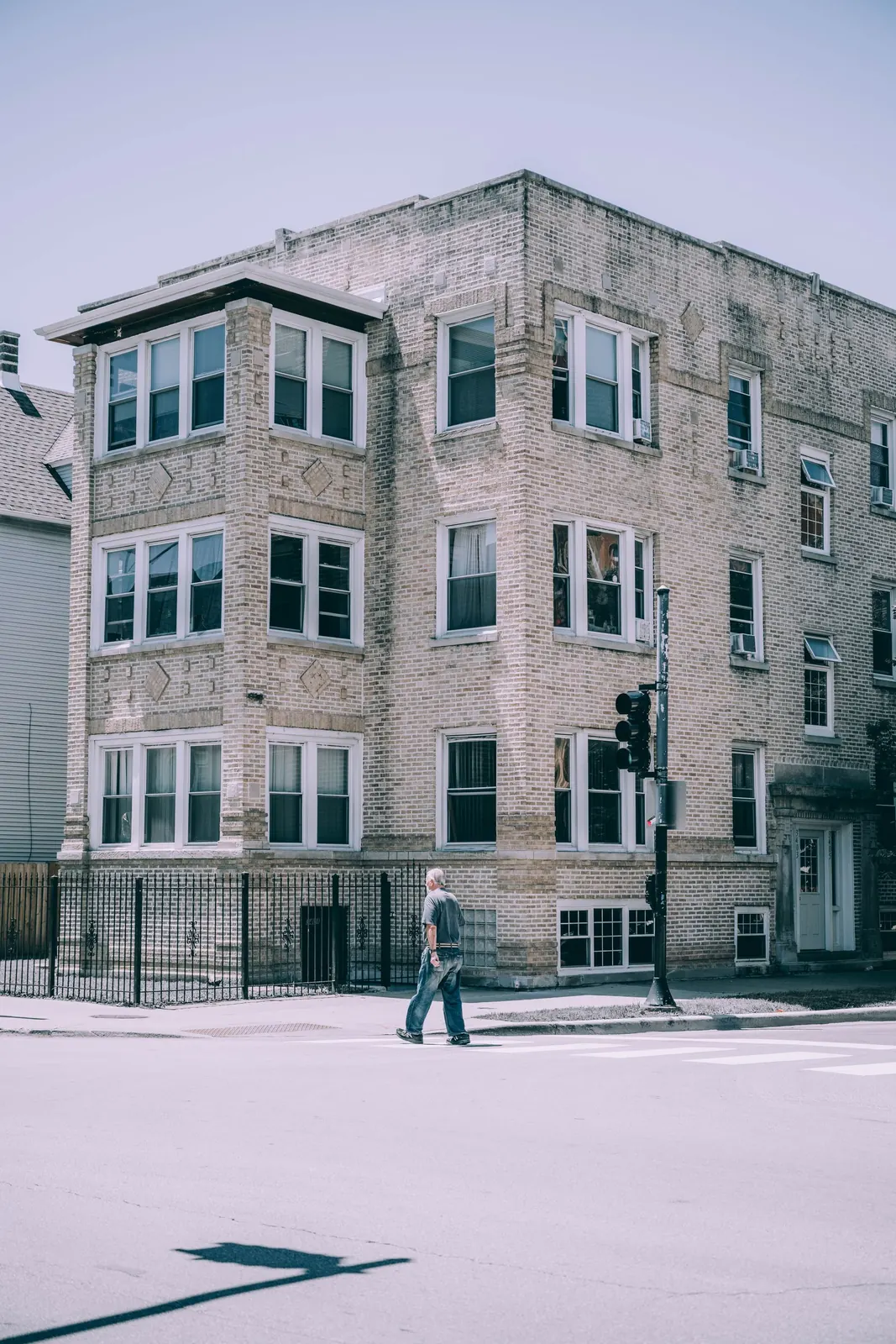
Who is responsible for a two-flat's shared chimney?
The chimney belongs to the building, so its upkeep falls to the owner, whether the owner lives in one unit or rents out both. Under Illinois law and the City of Chicago's rules, the owner also supplies and installs the CO alarms, while each tenant tests them and keeps the batteries working. One stack often holds several flues, and each one needs to be checked.
Chicago Chimney & Fireplace Repair · November 7, 2026
Why so many Chicago chimneys serve two homes
Census data from the 2020–2024 American Community Survey show that 13.1% of Chicago's housing units are in two-unit buildings and another 14.4% are in three- and four-unit buildings, against 3.4% and 4.3% for the country as a whole. In Berwyn, 15.1% of housing units are in two-unit buildings.
The Chicago Bungalow Association notes that brick two-flats were often built at the same time and by the same developers as bungalows, and describes them as a bungalow stacked on top of another. Locals call them two-flats, not duplexes. The chimney usually rises from the basement through both floors, carrying exhaust from each unit's appliances on the way.
One stack, several flues
A two-flat chimney is often several flues bundled in one brick stack. A common layout has one flue for each unit's furnace or boiler and water heater, and sometimes a separate flue for a fireplace. Over a century, appliances get replaced, flues get abandoned, and nobody keeps a record of which flue serves what.
- Two furnaces or a shared boiler, each with its own flue or sharing one.
- Water heaters left in a flue after a furnace was switched to side-wall venting.
- A fireplace flue that no one has used in years, sometimes blocked by debris or nests.
- An abandoned flue with an open thimble in a basement wall.
CO alarms: who does what
The Illinois Carbon Monoxide Alarm Detector Act, 430 ILCS 135, covers each unit of a multifamily building. The owner supplies and installs the alarms, gives one tenant in each unit written information on testing and maintenance, and makes sure batteries work when a tenant moves in. The tenant tests the alarms, replaces batteries and tells the owner in writing about problems they cannot fix.
The City of Chicago Department of Buildings adds its own placement rules: an alarm in the same room as every fuel-burning furnace, boiler and water heater, and inside any bedroom with a fireplace or fuel-burning appliance. In a two-flat with a basement full of appliances, that can mean several alarms in the basement alone. Owners face fines of $500 to $2,000 per day per violation, and the city's 3-1-1 line takes reports for rental buildings.
What tends to go wrong with two-flat chimneys
Two-flat chimneys are tall, and the top of the stack sits well above the roof, exposed on every side. That is where mortar washes out first and where the crown cracks. Many were built from Chicago common brick, which has not been made since 1981, so matching repairs use salvaged commons.
Inside, the risk is a flue that no longer fits its appliance or has collapsed tile at the base. Because the building has two households, a draft problem in one flue can affect people who never touch the appliance.
What it costs, and how we inspect
On bungalows and two-flats, chimney tuckpointing usually runs $500 to $2,500, and spalled brick replaced with salvaged commons runs $1,000 to $3,500. A liner for a gas furnace or water heater runs $625 to $2,250 in aluminum or $900 to $3,800 in stainless steel.
Our inspection is free. We map which appliance in which unit vents into which flue, check the top of the stack, and give the owner photos and a written price. We need access to the basement and, if a fireplace is in a unit, to that unit, so it helps to tell tenants ahead of time.
FAQ
More answers
Does each unit need its own chimney inspection?
One visit can cover the whole stack and every flue, as long as we can reach each appliance and fireplace.
Can a tenant book the inspection?
A tenant can call us, but repairs to the chimney are the owner's decision, so we send the report and price to the owner.
Do I need a CO alarm next to the boiler in a shared basement?
Under Chicago's rule, yes: an alarm in the same room as every fuel-burning furnace, boiler and water heater.
What about three-flats?
The same ideas apply, with more flues and more units. We map each one the same way.
Keep reading
More from the blog
 Where does Chicago require carbon monoxide alarms?Illinois requires a CO alarm within 15 feet of every bedroom. Chicago adds alarms inside bedrooms with a fireplace and next to every furnace, boiler and water heater.
 Do you need a permit to rebuild a chimney in Chicago?Chicago's Express Permit covers in-kind chimney rebuilds written on the permit; small in-kind repairs up to 50 sq ft need none, except possibly in landmark districts.
 What changes when your chimney is in a Chicago Landmark district?In a Chicago Landmark district the Historic Preservation Division reviews chimney permits. What that means for your chimney, plus Oak Park's own district rules.

Book online
Pick a day. We'll bring a ladder.
Free inspection in a 3-hour window: 8 to 11, 11 to 2, or 2 to 5. We call to confirm before we arrive.